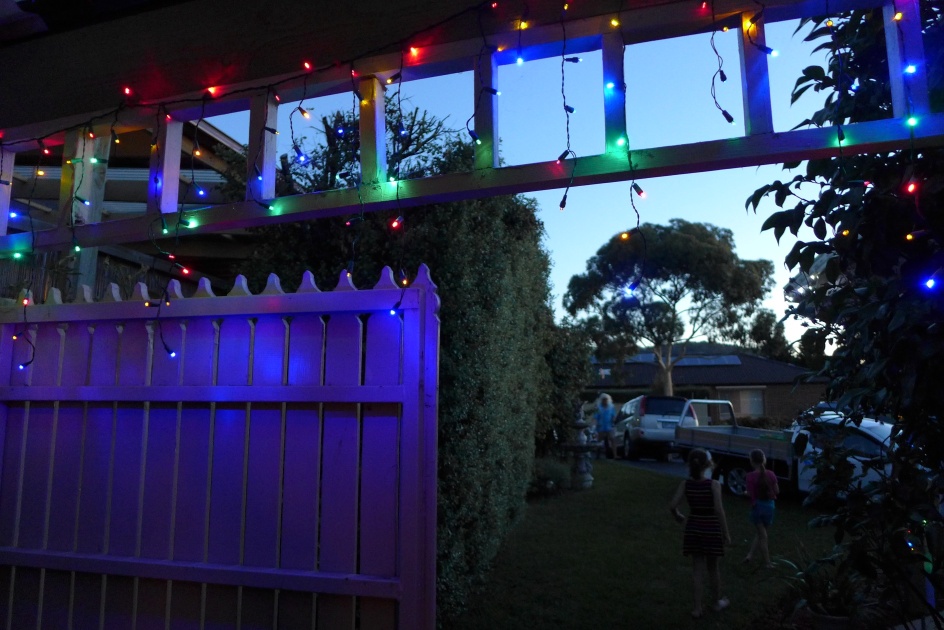
I had to pull myself out of bed this morning to try out how well the camera captures a sunrise. You'll have to take my word for it that the sunrise is quite accurately represented here.
F/3.5, 1/180s, ISO 80
The image below is a feature called "My Magic Frame". In this mode, you first capture an image to use as a background; in this case, a fishbowl. Then you mask out a desired area using the touchscreen. Then capture a second shot; in this case it is the dog. I ended with this gruesome picture of a decapitated dog's head inside a fishbowl! Sorry, Yuna!
Showing posts with label camera. Show all posts
Monday, January 26, 2015
Saturday, January 24, 2015
WB350F sample video and Motion Photo
This is shot at 1920x1080 resolution.
This is a frame grab from the above video clip.
This is an animated image (resolution fixed at 640x480). It is a feature Samsung calls "Motion Photo". Quite a fun feature to have, and not commonly found.
WB350F sample images - Zoom and Panorama
Here is a shot into the living room, followed by the same shot at 21x zoom. The camera was in fully auto mode, handheld. Notice that the second image appears to be quite stable, no doubt thanks to the image stabilizer at work.
F/6.3, 1/30s, ISO 240
F/6.9, 1/45s, ISO 400
The bottom two are panoramic shots of the living room. Camera was set in Panorama mode. The images appear as they are straight out of the camera. Despite very brightly lit windows, the exposure appears to be spot on.
F/4, 1/125s, ISO 320
F/4, 1/180s, ISO 320
Friday, January 23, 2015
Best wifi camera - Samsung WB350F
At a regular price of AUD$199, the Samsung WB350F is one of the best value-for-money pocketable point-and-shoot wifi camera one can get today. If you are a photographer and you yearn to have a high end smartphone simply because of its better image quality, this camera might make you think twice. The host of connectivity options is plentiful:
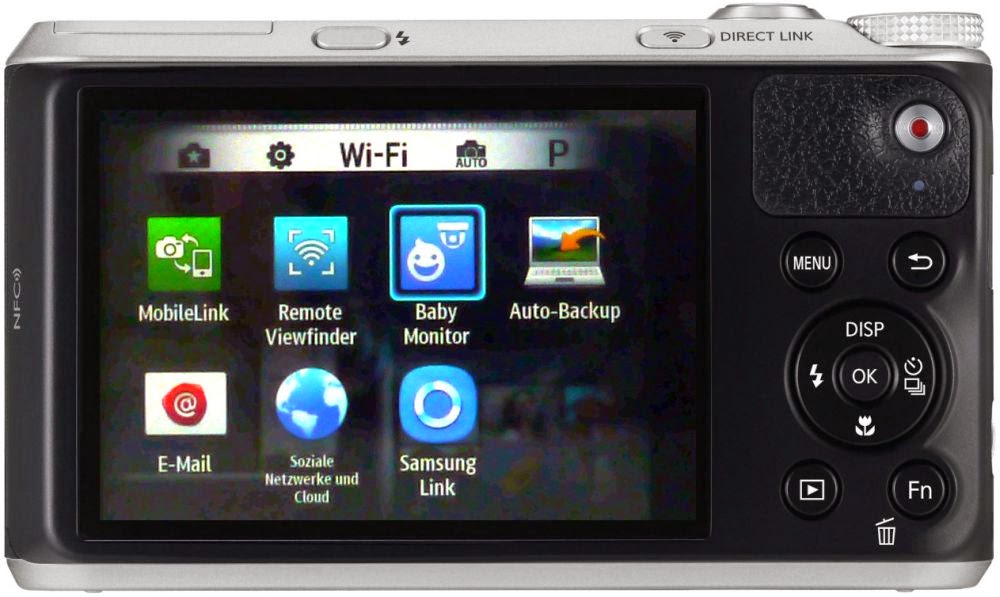
1. Built-in wifi hotspot. Some cameras use Eye-Fi for their wifi solution. (The Eye-Fi is a 3rd party flash memory card, and the wifi built into it does not work on all cameras.) With its built-in wifi hotspot. I can transfer an image to a smartphone or a tablet before or after taking the shot (prior download of app is required). I can also do batch transfer. I can preview the images either on the camera or on the smartphone. If enabled, I can transfer every shot as soon as it is taken (this happens in real time, but with a few seconds delay in between shots)
2. Built-in NFC. With one tap, I can transfer an image I am viewing, on to a NFC-enabled smartphone. Or, if in shooting mode, the WB350F will automatically turn the smartphone into a remote viewfinder for the camera. I can trigger the shot using the smartphone.
3. Built-in wifi recognition. The WB350F can detect and connect to any wifi hotspot out there. Note that not every wifi camera can do this. With this, I can email a photo straight from the camera to anyone; I can upload to cloud storage; and I can upload to social media like Facebook, Picasa, and Youtube.
With the above connectivity options, the WB350F is a perfect solution for anyone who has been exclusively shooting with a smartphone. This camera comes with a 1/2.3" BSI-CMOS sensor, which can be found in high-end smartphone cameras. Needless to say, the image quality is as just as good as or better than what you see in a top end Samsung Galaxy phone. The built-in effects and filters are available on both stills (16MP) as well as on video (1920x1080, 30fps).

Here are some of the other features I find to be either interesting or useful on the WB350F:
a. Touch screen display. Navigating on the menu is so much easier with a touch screen display, especially if you are trying to type out an email address.
b. Charging via USB port. I find this very, very handy indeed. No more one-of-a-kind charger to lug around.
c. Frame grab. While reviewing a video clip on the camera, I can simply extract a frame as a jpeg image. Alternatively, I can shoot a still image while recording a video.
d. Effects and filters. A full range of effects and filters, commonly found in a smartphone, is available on the WB350F. The effects and filters can be applied either before or after taking the shot.
e. Powerful white balance control. White balance can be set using AWB, one of the presets, setting colour temperature manually, or custom shooting into a white background. Each of the presets (e.g. Daylight) can also be fine-tuned to your liking.
Next time, I shall post some images taken with the WB350F. So far, I have found this to be a very delightful camera, having far more camera features and software features than any non-Samsung cameras, at any price. Yes, that says a lot!
Prior to this, I had planned to eventually upgrade to a high end smartphone simply for its better image quality. With the WB350F, I now have a real and dedicated camera with all the connectivity options and the fun-filled features of a smartphone, and an unrestrained battery life. As you can guess, I have struck the high end smartphone off my shopping list.
1. Built-in wifi hotspot. Some cameras use Eye-Fi for their wifi solution. (The Eye-Fi is a 3rd party flash memory card, and the wifi built into it does not work on all cameras.) With its built-in wifi hotspot. I can transfer an image to a smartphone or a tablet before or after taking the shot (prior download of app is required). I can also do batch transfer. I can preview the images either on the camera or on the smartphone. If enabled, I can transfer every shot as soon as it is taken (this happens in real time, but with a few seconds delay in between shots)
2. Built-in NFC. With one tap, I can transfer an image I am viewing, on to a NFC-enabled smartphone. Or, if in shooting mode, the WB350F will automatically turn the smartphone into a remote viewfinder for the camera. I can trigger the shot using the smartphone.
3. Built-in wifi recognition. The WB350F can detect and connect to any wifi hotspot out there. Note that not every wifi camera can do this. With this, I can email a photo straight from the camera to anyone; I can upload to cloud storage; and I can upload to social media like Facebook, Picasa, and Youtube.
With the above connectivity options, the WB350F is a perfect solution for anyone who has been exclusively shooting with a smartphone. This camera comes with a 1/2.3" BSI-CMOS sensor, which can be found in high-end smartphone cameras. Needless to say, the image quality is as just as good as or better than what you see in a top end Samsung Galaxy phone. The built-in effects and filters are available on both stills (16MP) as well as on video (1920x1080, 30fps).

Here are some of the other features I find to be either interesting or useful on the WB350F:
a. Touch screen display. Navigating on the menu is so much easier with a touch screen display, especially if you are trying to type out an email address.
b. Charging via USB port. I find this very, very handy indeed. No more one-of-a-kind charger to lug around.
c. Frame grab. While reviewing a video clip on the camera, I can simply extract a frame as a jpeg image. Alternatively, I can shoot a still image while recording a video.
d. Effects and filters. A full range of effects and filters, commonly found in a smartphone, is available on the WB350F. The effects and filters can be applied either before or after taking the shot.
e. Powerful white balance control. White balance can be set using AWB, one of the presets, setting colour temperature manually, or custom shooting into a white background. Each of the presets (e.g. Daylight) can also be fine-tuned to your liking.
Next time, I shall post some images taken with the WB350F. So far, I have found this to be a very delightful camera, having far more camera features and software features than any non-Samsung cameras, at any price. Yes, that says a lot!
Prior to this, I had planned to eventually upgrade to a high end smartphone simply for its better image quality. With the WB350F, I now have a real and dedicated camera with all the connectivity options and the fun-filled features of a smartphone, and an unrestrained battery life. As you can guess, I have struck the high end smartphone off my shopping list.
Friday, July 4, 2014
Cost of Micro Four Thirds camera vs Full Frame camera
Micro Four Thirds (MFT) camera bodies are relatively inexpensive, compared to a full frame (FF) camera, but the MFT lenses are much more expensive than FF camera lenses. Is the cost justified? Here is the math.
For this study, I compare a top tier full frame Nikon camera versus a top tier micro four thirds Olympus camera. I use a range of lenses that a serious general photographer might purchase, citing prices (in US$) from the reputable B&H store. For lenses, I chose FF lenses that are closest in focal length/maximum aperture to the MFT equivalent.
Nikon D800 (full frame sensor)
--------------------------------------
$2997: camera body
$121: 50mm f/1.8D lens
$360: 24mm f/2.8D AF
$899: 180mm f/2.8D
$670: 24-70mm f/2.8-f/4.0D
Total=$5047
Olympus OMD EM1 (micro four thirds sensor)
---------------------------------------------------------
$1399: camera body
$399: 25mm f/1.8 (*DOF=f/3.7) M.Zuiko
$799: 12mm f/2.0 (*DOF=f/4.0) M.Zuiko
$899: 75mm f/1.8 (*DOF=f/3.7) M.Zuiko
$999: 12-40mmf/2.8 (*DOF=f/5.6) M.Zuiko
Total=$4495
In summary, although a MFT camera body costs only about half of a FF body, the cost a complete lens/body system is actually only about 10% different.
You might notice that the true DOF difference is 2 f-stops worse in the MFT than in the FF system. Therefore the deal breaker is not in the price, but in the equivalent depth of field. That is to say, if you want maximum depth-of-field in your images, a FF camera is irreplaceable.
(*DOF = Depth of Field equivalent. A MFT sensor gives the lens a crop factor of 2. Not only is the focal length multiplied by a factor of 2, but the depth of field also increases by 2 f-stops)
For this study, I compare a top tier full frame Nikon camera versus a top tier micro four thirds Olympus camera. I use a range of lenses that a serious general photographer might purchase, citing prices (in US$) from the reputable B&H store. For lenses, I chose FF lenses that are closest in focal length/maximum aperture to the MFT equivalent.
Nikon D800 (full frame sensor)
--------------------------------------
$2997: camera body
$121: 50mm f/1.8D lens
$360: 24mm f/2.8D AF
$899: 180mm f/2.8D
$670: 24-70mm f/2.8-f/4.0D
Total=$5047
Olympus OMD EM1 (micro four thirds sensor)
---------------------------------------------------------
$1399: camera body
$399: 25mm f/1.8 (*DOF=f/3.7) M.Zuiko
$799: 12mm f/2.0 (*DOF=f/4.0) M.Zuiko
$899: 75mm f/1.8 (*DOF=f/3.7) M.Zuiko
$999: 12-40mmf/2.8 (*DOF=f/5.6) M.Zuiko
Total=$4495
In summary, although a MFT camera body costs only about half of a FF body, the cost a complete lens/body system is actually only about 10% different.
You might notice that the true DOF difference is 2 f-stops worse in the MFT than in the FF system. Therefore the deal breaker is not in the price, but in the equivalent depth of field. That is to say, if you want maximum depth-of-field in your images, a FF camera is irreplaceable.
(*DOF = Depth of Field equivalent. A MFT sensor gives the lens a crop factor of 2. Not only is the focal length multiplied by a factor of 2, but the depth of field also increases by 2 f-stops)
Sunday, December 30, 2012
Review of Panasonic LX7 - Part 5
The LX7 has a lot of fun built into it. I am sure other competing models will have many of these features too, but I am not sure each of them will work as well. The following are some of the features I think will be useful to me.
Be aware.....
Panoramic Mode:
I like the way the panorama mode works. A framing guideline appears on the LCD display to help you frame the shot. The image is captured buy panning from left to right, right to left, top to bottom, or bottom to top. You can hold the camera in portrait or landscape mode.
HDR Mode:
It captures three images when you press the shutter release. The resulting image clearly shows HDR at work.
Burst Mode:
The LX7 has a plethora of burst options: 2fps, 5fps, 11fps, 40fps, 60fps. The menu clearly indicates the resolution that the image will be captured in. Just hold the shutter release down and it fires away like a machine gun!
Movie Mode:
The movie mode is great. It has a choice of AVCHD (50fps on my PAL version) or MPEG4 (25fps). Movie resolution is up to full HD 1920x1080 pixels, or in VGA if so desired. There is a dedicated movie button, which can be used at any time regardless of what setting the camera is set at. Audio is recorded in stereo, with wind cut ability. Basically it does a fantastic job recording video; perhaps even better than a regular videocam. You can even capture a still picture while recording video.
Low light photography:
The image stabilizer is rock solid. I can shoot down to 1/10s handheld with no problem at all. Coupled with the cutting edge bright lens, this camera literally shines in low light and night photography.
1/13s
f1.4
ISO 800
Flexible Creative Modes:
The creative modes can be set before taking the shot, thus allowing you to visualize it on the LCD screen. Or, it can be added after the shot has been taken; the original image is preserved.
Be aware.....
The comparatively small-ish sensor of the LX7 does put a limit on image quality when pushed to extreme conditions, when compared with the likes of a DSLR. If one can accept this limitation, the LX7 is simply one of the best compacts there is at this time.
Sunday, December 23, 2012
Review of Panasonic LX7 - Part 4
This is the first time after a long hiatus that I have taken night shots with a compact camera. Back then, night shots in Auto mode were always a disaster. Here is how the LX7 performs. All the images below were taken in fully Auto mode, handheld. I have not compared it with any other cameras. Such may be the standard capability of modern day compacts but I do not know for sure.
ISO 400
1/13s
f1.4
25mm
ISO 400
1/20s
f1.4
25mm
ISO 1250
1/15s
f1.4
24mm
ISO 800
1/15s
f1.4
24mm
ISO 1000
1/15s
f1.4
24mm
Verdict: I can only say I am impressed with the night shot capability. It captures a night scene as it actually looks, rather than trying to over-brighten a night scene with extremely high ISO or extremely slow shutter speed. My guess is that it has something to do with automatically invoking the Night Scene mode when it detects one.
1/13s
f1.4
25mm
ISO 400
1/20s
f1.4
25mm
ISO 1250
1/15s
f1.4
24mm
ISO 800
1/15s
f1.4
24mm
ISO 1000
1/15s
f1.4
24mm
ISO 400
1/50s
f1.4
24mm
Saturday, December 22, 2012
Review of Panasonic LX7 - Part 3
I thought it might be interesting to see how well a compact camera can shoot in a studio set up. The following shots were taken in Aperture Priority mode with spot metering.
For the shots, I had a continuous light source from one direction and a black backdrop. The photos were shot handheld. All images shown are straight out of the camera.
Verdict: Images are sharp, backdrop is successfully darkened, tonality is good. The white balance is not consistent, however. But that can be easily corrected. Perhaps I should attempt Manual mode or Portait Mode next time. I guess the question is, would I ditch my DLSR and start doing studio shots with this camera? It is too soon to tell, but the prognosis is good.
50mm
1/250s
f3.2
ISO 100

50mm
1/320s
f1.9
ISO 80
50mm
1/160s
f1.9
For the shots, I had a continuous light source from one direction and a black backdrop. The photos were shot handheld. All images shown are straight out of the camera.
Verdict: Images are sharp, backdrop is successfully darkened, tonality is good. The white balance is not consistent, however. But that can be easily corrected. Perhaps I should attempt Manual mode or Portait Mode next time. I guess the question is, would I ditch my DLSR and start doing studio shots with this camera? It is too soon to tell, but the prognosis is good.
50mm
1/250s
f3.2
ISO 100

50mm
1/320s
f1.9
ISO 80
50mm
1/160s
f1.9
ISO 80
Friday, December 21, 2012
Review of Panasonic LX7 - Part 2
This time I want to see how well the Panasonic LX7 does in zoom. The LX7 has a 3.8x optical zoom, which can "zoom" a further 2x in digital zoom, giving it the 35mm equivalent of 180mm lens. The result is very satisfactory.
Here are the images taken in my garden with receding daylight in my garden. The first image is shot wide open at 24mm. The second is shot at full optical zoom. The last is shot at the full optical+digital zoom, giving the equivalent of roughly 8x. The last image is shot at 1/125s, ISO 125. All three images were shot handheld in fully automatic mode.
Verdict: The zoomed-in image is sharp, in focus, and well exposed.

24mm
90mm
180mm
Here are the images taken in my garden with receding daylight in my garden. The first image is shot wide open at 24mm. The second is shot at full optical zoom. The last is shot at the full optical+digital zoom, giving the equivalent of roughly 8x. The last image is shot at 1/125s, ISO 125. All three images were shot handheld in fully automatic mode.
Verdict: The zoomed-in image is sharp, in focus, and well exposed.
24mm
90mm
180mm
Review of Panasonic LX7 - Part 1
So far so good.... I have got my Panasonic LX7 for four days now. I am testing out the images to see if it meets my needs for lightweight travel photography. (I've decided to go on my next trip with minimum photography gear)
Tested out the LX7 for low light photography. The subject is visible with a bit of light coming from other rooms. I compared the LX7 against the Samsung S2 smartphone, which normally takes "good enough" photos in restaurant lighting. All imahes were shot handheld in fully automatic mode, without a flash.
Verdict: The LX7 is outstanding in comparison with the other two. The S2 has dropped the ball on this one. The very old Canon IXUS 50 is unsurprisingly just as bad.
Panasonic LX7
ISO 400
1/6 sec
f/1.4
Tested out the LX7 for low light photography. The subject is visible with a bit of light coming from other rooms. I compared the LX7 against the Samsung S2 smartphone, which normally takes "good enough" photos in restaurant lighting. All imahes were shot handheld in fully automatic mode, without a flash.
Verdict: The LX7 is outstanding in comparison with the other two. The S2 has dropped the ball on this one. The very old Canon IXUS 50 is unsurprisingly just as bad.
Panasonic LX7ISO 400
1/6 sec
f/1.4
Monday, November 19, 2012
Emerging feature in digital cameras
There is an increasingly common feature in digital cameras: connectivity. As more and more people take to photography, albeit using their smartphones, many non-techies are expecting to be able to post their photos to the social media effortlessly. That means, directly from the camera.
Here are some of the ways and means:
1. Samsung and Nikon introduced their Android cameras (i.e the Galaxy Camera and the S800c, respectively just less than 6 months ago. It was a great idea at that time, but now it is looking dated.
2. Samsung, Panasonic, Sony, and perhaps a few others have also included a built-in wifi in some of their cameras even before the Android cameras came out. The idea was good, but the implementation was too cumbersome to catch on seriously.
3. Eye-fi introduced a new technology several years ago where wifi is built into the SD card. This works only on a select number of cameras. While it is able to transfer images automatically to the smartphone or the PC, I find it to be too cumbersome to use regularly. Transferring images is an all-or-nothing affair. You either set it to transfer all images or none. You can also set it to transfer from camera to smartphone for immediate viewing after a shot, either in full resolution or none.
Fortunately, technology keeps evolving. Last week Transcend announced their SD Wifi memory card that promises to do a better job. Working like the Eye-fi, the smartphone app is much more straightforward It is a lot easier to set up for connecting to the camera. You can choose to "shoot and view", or "browse" after a shooting spree. How well it actually performs remains to be seen because at this moment there has been no reviews yet.
Wifi built into the camera is not dead. Canon's latest DSLR announcement, the Canon 6D (full frame camera) has a built-in wifi feature that does an impressive job. You can view-focus-shoot straight from a smartphone app, or browse the shots residing in your camera directly from the smartphone or PC. Then you can select which ones to download and send to social media. When downloading to a smartphone, it reduces the RAW or JPEG image to 1920x1080 resolution, which increases the transfer speed and also makes it more suitable for social media. This is the most impressive camera wifi implementation I have seen.
I believe this trend in camera connectivity has taken a serious turn and will be a standard feature in the next Photokina exhibition.
Here are some of the ways and means:
1. Samsung and Nikon introduced their Android cameras (i.e the Galaxy Camera and the S800c, respectively just less than 6 months ago. It was a great idea at that time, but now it is looking dated.
2. Samsung, Panasonic, Sony, and perhaps a few others have also included a built-in wifi in some of their cameras even before the Android cameras came out. The idea was good, but the implementation was too cumbersome to catch on seriously.
3. Eye-fi introduced a new technology several years ago where wifi is built into the SD card. This works only on a select number of cameras. While it is able to transfer images automatically to the smartphone or the PC, I find it to be too cumbersome to use regularly. Transferring images is an all-or-nothing affair. You either set it to transfer all images or none. You can also set it to transfer from camera to smartphone for immediate viewing after a shot, either in full resolution or none.
Fortunately, technology keeps evolving. Last week Transcend announced their SD Wifi memory card that promises to do a better job. Working like the Eye-fi, the smartphone app is much more straightforward It is a lot easier to set up for connecting to the camera. You can choose to "shoot and view", or "browse" after a shooting spree. How well it actually performs remains to be seen because at this moment there has been no reviews yet.
Wifi built into the camera is not dead. Canon's latest DSLR announcement, the Canon 6D (full frame camera) has a built-in wifi feature that does an impressive job. You can view-focus-shoot straight from a smartphone app, or browse the shots residing in your camera directly from the smartphone or PC. Then you can select which ones to download and send to social media. When downloading to a smartphone, it reduces the RAW or JPEG image to 1920x1080 resolution, which increases the transfer speed and also makes it more suitable for social media. This is the most impressive camera wifi implementation I have seen.
I believe this trend in camera connectivity has taken a serious turn and will be a standard feature in the next Photokina exhibition.
Thursday, October 4, 2012
An alternative to the Android camera
I recently wrote about the Android cameras which have just been announced - the Samsung Galaxy Camera and the Nikon S800C. I was so smitten by the idea then that I couldn't wait to get one of them. I must say my enthusiasm has diminished by now. It is a mistake for companies to announce products without being able to sell them immediately. In my case, the longer I wait, the less likely I am to make an impulse purchase.
I ask myself why I thought I needed an Android camera. Well, it seems to be a great way to play with all the camera-related apps out there, and it is much easier to share photos on a social website. But realistically speaking, all I ever wanted was to be able to selectively upload some photos after a shoot.
So here is Panasonic's answer to the challenge of providing connectivity to the camera. The newly announced SZ5 features wifi connectivity. It costs about $200 and is designed for the casual shooter. By installing a free app called Lumix Link on your iOS or Android device, you can view, control, and shoot wirelessly with your tablet or smartphone.
I believe it is also possible to shoot first with the SZ5, and then use your mobile device to view the pictures and upload to your tablet, or your computer or straight to one of the popular social websites.I prefer this wifi feature to having a full-blown Android on my camera. Really.
I hope more camera manufactures will equip their cameras with wifi. It will be so useful. Imagine being able to immediately email off an image straight from the camera, or simply post it on Facebook. It should not add a lot of cost, and it will make the camera a more connected device. Will there still be a market for an Android camera? Maybe not, if there are more wifi cameras around.
Unfortunately for the SZ5, the reviews on its image quality are not too good, although this camera is packed with quite the latest features in low end point-and-shoot cameras. I hope to see some higher-end cameras touting this wifi.
I ask myself why I thought I needed an Android camera. Well, it seems to be a great way to play with all the camera-related apps out there, and it is much easier to share photos on a social website. But realistically speaking, all I ever wanted was to be able to selectively upload some photos after a shoot.
So here is Panasonic's answer to the challenge of providing connectivity to the camera. The newly announced SZ5 features wifi connectivity. It costs about $200 and is designed for the casual shooter. By installing a free app called Lumix Link on your iOS or Android device, you can view, control, and shoot wirelessly with your tablet or smartphone.
I believe it is also possible to shoot first with the SZ5, and then use your mobile device to view the pictures and upload to your tablet, or your computer or straight to one of the popular social websites.I prefer this wifi feature to having a full-blown Android on my camera. Really.
I hope more camera manufactures will equip their cameras with wifi. It will be so useful. Imagine being able to immediately email off an image straight from the camera, or simply post it on Facebook. It should not add a lot of cost, and it will make the camera a more connected device. Will there still be a market for an Android camera? Maybe not, if there are more wifi cameras around.
Unfortunately for the SZ5, the reviews on its image quality are not too good, although this camera is packed with quite the latest features in low end point-and-shoot cameras. I hope to see some higher-end cameras touting this wifi.
Saturday, July 14, 2012
Camera trends
Photography has always been a evolving, but never quite a dramatic as at the present moment. It seems that every year or two brings yet another wave of improvements that makes for a very compelling reason to upgrade. The present crop of low cost entry-level digicams are more than capable of replacing a whole bagful of camera gear (camera, videocam, chargers, lenses, filters, etc.) that some of us can reminisce of carrying on a fondly-remembered family vacation. We still have the poorly exposed pictures and nausea-inducing videos as proof.
Here are some of the exciting trends I can foresee or hope to see in the world of photography.
A) Fast learning curve (scene-based shooting)
Of course this is not new, but it is getting better all the time. Unlike the physical components of a camera, software and processor speed keeps on improving. I guess we just have to use it to believe that even seasoned photographers may one day be using scene modes as comfortably as using manual mode. What is easier and faster than using scene modes in a constantly changing environment like shooting a wedding? Added to that, I would like to see advanced settings in scene mode for pro users to fine tune on the fly.
B) Perfect focusing (touch and shoot)
How many times have we sighed over an otherwise great shot, because the focus is at the wrong spot? With touchscreen coming to cameras, some cameras (e.g. Olympus OMD EM5) allow you to touch at the point where you want the focus to be, and also trigger the shot at the same time. I would love to see that in more cameras. This innovation comes from smartphone apps, which goes to show camera manufacturers have not been thinking outside the box. I would like to see a mini touchpad (like in a Blackberry phone) for the thumb to move a cursor quickly when shooting through an electronic viewfinder. This will enable a pro shooter to shoot faster while still holding the camera with both hands for stability.
C) One-touch post processing
Every professional photographer does post processing to a varying degree. Smartphone apps developers pioneered this. Many new cameras now feature art effects to attract the new generation of users. Existing post processing software like Lightroom and many others already have "presets" to do what I call one touch processing. What I would like to see is more finesse and sophistication, instead of the usual kitschy art effects like retro effect, pop art, film negative, etc. I would like to see each preset come with advanced setting sliders that allow the user to fine tune to his taste.
D) Tripod-free, flash-free shooting (super high ISO)
There was a time when you couldn't possibly shoot at night without a flash (read: film days). With a decent smartphone you can shoot a reasonably good image at night without a flash or a tripod. While lens technology is already bound by the laws of optics, sensor technology is still evolving.
E) Miniaturization (including full frame DSLR)
I believe a light-weight and slimmer full frame DSLR is bound to emerge. There is really no need for a reflex camera, the reason for the weight and bulk of a DSLR body. CSC's (Compact System Camera) such as Panasonic GF series, the Sony NEX, and many others have demonstrated that there is no advantage to hanging on to the reflex mirror.
Let's see what this year's Photokina will bring in terms of cameras. It will be held in two month's time!
Here are some of the exciting trends I can foresee or hope to see in the world of photography.
A) Fast learning curve (scene-based shooting)
Of course this is not new, but it is getting better all the time. Unlike the physical components of a camera, software and processor speed keeps on improving. I guess we just have to use it to believe that even seasoned photographers may one day be using scene modes as comfortably as using manual mode. What is easier and faster than using scene modes in a constantly changing environment like shooting a wedding? Added to that, I would like to see advanced settings in scene mode for pro users to fine tune on the fly.
B) Perfect focusing (touch and shoot)
How many times have we sighed over an otherwise great shot, because the focus is at the wrong spot? With touchscreen coming to cameras, some cameras (e.g. Olympus OMD EM5) allow you to touch at the point where you want the focus to be, and also trigger the shot at the same time. I would love to see that in more cameras. This innovation comes from smartphone apps, which goes to show camera manufacturers have not been thinking outside the box. I would like to see a mini touchpad (like in a Blackberry phone) for the thumb to move a cursor quickly when shooting through an electronic viewfinder. This will enable a pro shooter to shoot faster while still holding the camera with both hands for stability.
C) One-touch post processing
Every professional photographer does post processing to a varying degree. Smartphone apps developers pioneered this. Many new cameras now feature art effects to attract the new generation of users. Existing post processing software like Lightroom and many others already have "presets" to do what I call one touch processing. What I would like to see is more finesse and sophistication, instead of the usual kitschy art effects like retro effect, pop art, film negative, etc. I would like to see each preset come with advanced setting sliders that allow the user to fine tune to his taste.
D) Tripod-free, flash-free shooting (super high ISO)
There was a time when you couldn't possibly shoot at night without a flash (read: film days). With a decent smartphone you can shoot a reasonably good image at night without a flash or a tripod. While lens technology is already bound by the laws of optics, sensor technology is still evolving.
E) Miniaturization (including full frame DSLR)
I believe a light-weight and slimmer full frame DSLR is bound to emerge. There is really no need for a reflex camera, the reason for the weight and bulk of a DSLR body. CSC's (Compact System Camera) such as Panasonic GF series, the Sony NEX, and many others have demonstrated that there is no advantage to hanging on to the reflex mirror.
Let's see what this year's Photokina will bring in terms of cameras. It will be held in two month's time!
Tuesday, July 3, 2012
Sony Alpha NEX-5N review
Trying out a new camera is always fun for me, especially
when it is one of the more popular ones. This week I have the good
fortune of testing out the Sony NEX-5N. I am delighted with the image quality and the fast and sharp focusing. When set in iAuto mode, taking a sharp and well-exposed pictures is, well, just a snap.
So what sets this camera apart from the average mid-range shooter? The controls are very well laid out. It has a touchscreen LCD (which I don't care much about). However, as far as I know, all the items on the screen can alternatively be selected by the use of the two context buttons and the control wheel (think of a Nokia phone's four-way controller and two selection buttons, held sideways). I wish it had physical buttons for ISO and metering, though, for faster operation.
I liked the panorama mode (see below). It does an excellent job of stitching up the shots for you in an effortless way. I like the ability to shoot at very high ISO without visible loss of quality (see picture of cables below, taken at ISO 12800 at 1/80 sec. I think the image stabilization works very well, as almost every shot I took showed no sign of camera shake. The colours are lovely and accurate, thanks to good auto white balance.
There are many camera effects to play with, although I think not many serious photographers will make use of them very often.
Overall, I find this a highly capable camera. The lack of sufficient physical buttons will slow down your work - not so good if you are shooting sports or wedding. It is great for casual shooting and for taking with you on a vacation. There are enough capabilities to match a regular DSLR, if you can afford to call up the menus.


Thursday, April 22, 2010
Notes to myself: best travel compact cameras
Here are the top end of the range for compact travel cameras. This class of cameras is characterized by a long zoom housed in a compact body, while maintaining good image quality. Naturally this comes with a big price tag. The success of this particular breed must be attributed to Panasonic's TZ ("travel zoom") range. Following Panasonic's success, the other manufacturers have followed suit with their own travel compacts. Here are the latest models worth comparing (prices quoted by Ted's Camera. All models released in Jan-Feb 2010):
Panasonic Lumix DMC-ZS7 (DMC-TZ10), AUD$700, 12x zoom
Sony Cybershot DSC HX5, AUD$600, 10x
Nikon S8000, AUD$500, 10x
Canon SX210IS, AUD$550, 14x
I have yet to see professional reviews of the image quality of each camera. Based solely on published specs, my choice is in the sequence presented above, highest being the Panasonic Zs7. This camera has the best range of max lens aperture among the lot. Sony HX5 has the best video. Nikon has the best LCD screen. All things considered, I believe the ZS7 will give me the best satisfaction as a travel compact, while the Hx5 comes in as a very close second. The Lumix has brighter lens, longer flash, 460k LCD (Sony's is 230k). It has aperture priority and shutter priority. On the otherhand, Sony's full HD video is very alluring. The 10fps burst speed coupled with 60fps HD video makes it a good choice for action photography. While no aperture and shutter priority, it has manual focus which the Lumix doesn't.
Both Zs7 and HX5 have GPS, while the other two models don't. Likewise for 25mm wide angle.
My only gripe? None of them shoot RAW.
How about Canon G11 and the likes of it? Bah... same small sensor size. Might as well go for the above.
Panasonic Lumix DMC-ZS7 (DMC-TZ10), AUD$700, 12x zoom
Sony Cybershot DSC HX5, AUD$600, 10x
Nikon S8000, AUD$500, 10x
Canon SX210IS, AUD$550, 14x
I have yet to see professional reviews of the image quality of each camera. Based solely on published specs, my choice is in the sequence presented above, highest being the Panasonic Zs7. This camera has the best range of max lens aperture among the lot. Sony HX5 has the best video. Nikon has the best LCD screen. All things considered, I believe the ZS7 will give me the best satisfaction as a travel compact, while the Hx5 comes in as a very close second. The Lumix has brighter lens, longer flash, 460k LCD (Sony's is 230k). It has aperture priority and shutter priority. On the otherhand, Sony's full HD video is very alluring. The 10fps burst speed coupled with 60fps HD video makes it a good choice for action photography. While no aperture and shutter priority, it has manual focus which the Lumix doesn't.
Both Zs7 and HX5 have GPS, while the other two models don't. Likewise for 25mm wide angle.
My only gripe? None of them shoot RAW.
How about Canon G11 and the likes of it? Bah... same small sensor size. Might as well go for the above.
Tuesday, April 6, 2010
My Bloggie shot
These houses line the bank of the Moyne River in Port Fairy, where a group of us went for the Easter weekend. Doubleclick on the picture to see the enlarged image. I like to imagine that this scene is in Europe. This picture was taken with my Bloggie camera, with very little post processing. I came out to take a walk when everyone was still sleeping. I was well rewarded with some pretty good shots that morning.
Monday, December 28, 2009
My new camera bag: Lowepro Fastpack 200
I like to do some research before buying something. There's a certain thrill about gathering information and making the best decision. There's always lots of choices and often the best choice depends on the individual user's needs. After some research, I narrowed down my choices to the Lowerpro brand, and the models Trekker, Slingshot, or Fastpack. Each of these models are available in different sizes. Lowepro is to camera bags is like Manfrotto is to tripods. I ended up buying the Fastpack 200 for these reasons: When I go out on a photo shoot, I will be selective in what gear I need to carry and it will be weight-limited so as not to bog me down. The Mini Trekker carries a lot of lenses, but will probably be left at home to house my gear rather than carried around on trips. The Slingshot is great for fast access but has only one strap which makes it tiring to carry for a long period of time.
Fastpack 200 is just the right size and the right design for me. I can carry it as a backpack. I can have fast access to the side pocket. The general compartment above the camera compartment is useful to carry anything on a day trip, or to carry more gear (like chargers, flash guns, filters, or even a back-up camera). I took it to a wedding yesterday. Left on the floor, I could access the top compartment easily. When following the guests around, I could carry the bag on one shoulder and fast-access the side pocket to grab my camera. Plus, I still have lots of room left over for future acquisitions.


Fastpack 200 is just the right size and the right design for me. I can carry it as a backpack. I can have fast access to the side pocket. The general compartment above the camera compartment is useful to carry anything on a day trip, or to carry more gear (like chargers, flash guns, filters, or even a back-up camera). I took it to a wedding yesterday. Left on the floor, I could access the top compartment easily. When following the guests around, I could carry the bag on one shoulder and fast-access the side pocket to grab my camera. Plus, I still have lots of room left over for future acquisitions.


Wednesday, November 11, 2009
What makes a good camera
Only a few days ago I was thinking about what kind of camera I would like to get next. I thought it would be a terrific idea to get a really good point-and-shoot. That will do nicely when I go on a holiday. It will save me from carrying a lot of gear. Oh yes, it must have an articulated LCD for me to get those type of shots that you don't normally get looking through a viewfinder. But it must have a really good sensor; at least an APS-C or a Four-Thirds sensor, because I am a firm believer that a good sensor makes a good camera.
Tonight at the camera club my appetite for a good sensor is further increased. Ron Cork showed pictures taken on his Europe trip. The pictures taken in low light at high ISO strongly convinced me that the crucial factor in today's camera lies in the sensor. Technology has blurred the gap between cameras on things like shutter lag, image stabilization, and ease of use. Lens technology is nothing new and you'll always get what you pay for. Gimmicks like face recognition, water proofing, and ultra-zoom are just that: gimmicks.
The distinguishing feature lies in the sensor. I believe even the sensors used in the best DLSR's today are still evolving. In the D700, it has reached a point where you can take most pictures in low light condition without using a tripod (there you go: less gear to carry on your holiday. Just make sure you have a very fast lens, though). I mean good pictures and not grainy ones you get when you bump up the ISO in a cheap camera. I believe there will come a time when one can shoot in any lighting condition without using a tripod or a fast lens. It is unlikely that such a super sensor will be cheap or available soon, I think it is better to get a fast lens as my next acquisition, instead of chasing after a dream camera. It is like buying a computer. You only buy the fastest processor to suit your needs at that time. As I am still learning how to shoot well, I think I could live with my humble D90 for some time yet. I could do with a fast lens though, and I think I'll forget about getting a point-and-shoot camera now, no matter how good the successor to Panasonic LX3 or Canon G11 comes long. Someday I'll go after the best-in-class sensor. Just not now.
Tonight at the camera club my appetite for a good sensor is further increased. Ron Cork showed pictures taken on his Europe trip. The pictures taken in low light at high ISO strongly convinced me that the crucial factor in today's camera lies in the sensor. Technology has blurred the gap between cameras on things like shutter lag, image stabilization, and ease of use. Lens technology is nothing new and you'll always get what you pay for. Gimmicks like face recognition, water proofing, and ultra-zoom are just that: gimmicks.
The distinguishing feature lies in the sensor. I believe even the sensors used in the best DLSR's today are still evolving. In the D700, it has reached a point where you can take most pictures in low light condition without using a tripod (there you go: less gear to carry on your holiday. Just make sure you have a very fast lens, though). I mean good pictures and not grainy ones you get when you bump up the ISO in a cheap camera. I believe there will come a time when one can shoot in any lighting condition without using a tripod or a fast lens. It is unlikely that such a super sensor will be cheap or available soon, I think it is better to get a fast lens as my next acquisition, instead of chasing after a dream camera. It is like buying a computer. You only buy the fastest processor to suit your needs at that time. As I am still learning how to shoot well, I think I could live with my humble D90 for some time yet. I could do with a fast lens though, and I think I'll forget about getting a point-and-shoot camera now, no matter how good the successor to Panasonic LX3 or Canon G11 comes long. Someday I'll go after the best-in-class sensor. Just not now.
Tuesday, September 1, 2009
New Panasonic DSLR: DMC GF1
What a busy week it has been! First, Sony introduced its high end DSLR, the affordable full frame A850. Four days later, Canon announced its EOS 7D, their highest end APS-C frame DLSR. One day later, today, Panasonic announces its most advanced Four-Thirds DLSR. It is an exciting product to watch. Here's the deal.
This is a camera that will seriously compete against the high end compact cameras. Professionals and amateurs alike buy the high end compacts (e.g. Canon G10) because they are small to carry everywhere and yet take pretty good pictures. Yes, even pro shooters sometimes opt for compacts when they go on holidays.
The Panasonic GF1 is about the same size as the Canon G10, but offers all the advantages of a DSLR: interchangeable lens, Four-Thirds sensor, SLR controls. Like a serious compact, it also offers Live View, HD movie with a dedicated record button, wind-cut for noise reduction, built-in flash as well as flash hot-shoe. Also, the fact that this innovative DLSR has done away with the mirror mechanism means that you can put the camera in silent mode. Great for use when you are shooting animals or birds. One nice touch is the option to record video in either AVCHD format or MJPEG. Both have pros and cons, so it is good to have the choice.
Help me; I feel like running out to buy this camera! This is an ideal camera to take on a holiday. The only thing that is holding me back is the lack of a fully articulated LCD, which allows one to hold the camera at any angle. Seriously!
This is a camera that will seriously compete against the high end compact cameras. Professionals and amateurs alike buy the high end compacts (e.g. Canon G10) because they are small to carry everywhere and yet take pretty good pictures. Yes, even pro shooters sometimes opt for compacts when they go on holidays.
The Panasonic GF1 is about the same size as the Canon G10, but offers all the advantages of a DSLR: interchangeable lens, Four-Thirds sensor, SLR controls. Like a serious compact, it also offers Live View, HD movie with a dedicated record button, wind-cut for noise reduction, built-in flash as well as flash hot-shoe. Also, the fact that this innovative DLSR has done away with the mirror mechanism means that you can put the camera in silent mode. Great for use when you are shooting animals or birds. One nice touch is the option to record video in either AVCHD format or MJPEG. Both have pros and cons, so it is good to have the choice.
Help me; I feel like running out to buy this camera! This is an ideal camera to take on a holiday. The only thing that is holding me back is the lack of a fully articulated LCD, which allows one to hold the camera at any angle. Seriously!
Tuesday, August 25, 2009
Canon Powershot G11
Here is a compact camera worth considering. The newly released Powershot G11 is a compact camera that should satisfy a large segment of users, from professionals to non-photographers who want a very good camera without all the hassles of an SLR. My enthusiasm for this camera is solely based on the information released on 19th Aug 2009. I am sure that before long there will be many reviews abuzz on the internet. Chances are, the reviews will be good based on the pedigree of this model, going all the way back to the highly popular G5. The G series has since become a compact camera of choice among DSLR users who need a backup, carry-anywhere camera.
G11 brings back the articulated LCD, much to my delight. Movie resolution is still 640x480 30fps, but in the newer H.264 format. Flash sync speed has increased to 1/2000sec, while max ISO went upto 3200 from 1600 . Apart from those, the other critical specs are still the same as for the G10: 5x zoom, f2.8 lens with F2.8-F4.5 maximum aperture. Pixel count dropped from 14MP to 10MP in the G11 (but supposedly better sensitivity CCD).
Spec-wise, the G11 could do better by giving us HD movie and F2.0-3.0 lens (as it did with the G5 a long time ago). I would be happy to pick this one up if I were to get a new compact camera today.
G11 brings back the articulated LCD, much to my delight. Movie resolution is still 640x480 30fps, but in the newer H.264 format. Flash sync speed has increased to 1/2000sec, while max ISO went upto 3200 from 1600 . Apart from those, the other critical specs are still the same as for the G10: 5x zoom, f2.8 lens with F2.8-F4.5 maximum aperture. Pixel count dropped from 14MP to 10MP in the G11 (but supposedly better sensitivity CCD).
Spec-wise, the G11 could do better by giving us HD movie and F2.0-3.0 lens (as it did with the G5 a long time ago). I would be happy to pick this one up if I were to get a new compact camera today.
Subscribe to:
Posts (Atom)